 EN
EN
 RU
RU CN
CNHow to Import Products from a Marketplace into an Online Store via API
Marketplaces can serve not only as sales channels but also as sources of products for online stores, dropshipping businesses, and other e-commerce services. Taobao, 1688, Alibaba, AliExpress, Amazon, eBay, and other platforms offer millions of products that can be used to build your own catalog.
If you only work with a small number of products, their information can be transferred manually. However, this approach becomes inefficient as the catalog grows: you need to copy titles and descriptions, upload images, transfer product attributes and variants, set prices, and then keep track of changes to the original product data.
APIs make it possible to automate this process. An online store can retrieve product information from a marketplace and use it to create and subsequently update its own catalog.
What Is Product Import via API?
Product import via API is the automated transfer of product information from a marketplace to an online store or another e-commerce system.
Instead of creating product pages manually, the store sends a request to an API and receives structured product data. Depending on the marketplace and its API capabilities, this data may include product titles, descriptions, images, prices, attributes, variants, seller information, and other details.
The online store can process the received data before publishing it. For example, descriptions can be translated into another language, prices can be converted into another currency, markups can be applied, or product attributes can be adapted to the store’s own catalog structure.
This approach is especially useful for stores with large catalogs and projects that use marketplaces as a continuous source of products.
How Does Product Import via API Work?
The process starts with requesting information about a product from a marketplace and ends with creating a complete product page in the online store. The exact implementation depends on the marketplace and the e-commerce platform, but the general workflow usually looks like this:
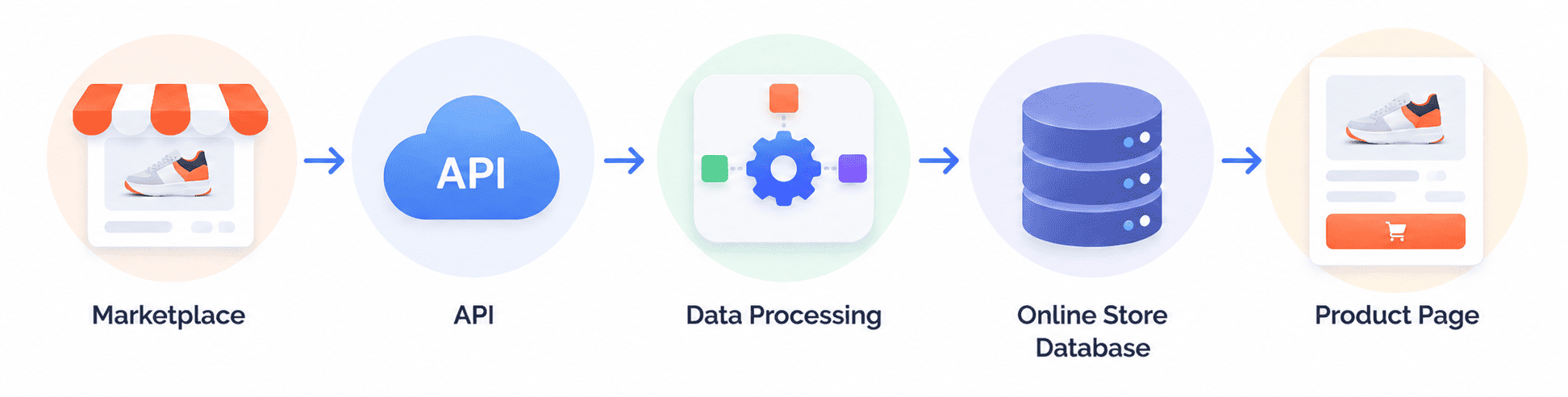
First, the online store sends a request to the marketplace API. For example, the request may contain a product ID or a link to its marketplace page. The API retrieves the current product information and returns it in a structured format, usually JSON.
The received data is then processed before being saved to the online store. At this stage, the system can translate text, convert currencies, calculate the final price based on markup rules, map categories and attributes, and determine which data should be stored.
After processing, the information is saved in the online store’s database and used to create the product page. If necessary, the store can periodically request the data again to update prices, availability, and other information that may change over time.
The exact set of available data depends on the marketplace and its API. Product imports can typically include:
- product title and description;
- main and additional images;
- current price and other available pricing information;
- product attributes;
- categories;
- product variants, such as color, size, or configuration;
- SKUs and product or variant identifiers;
- availability information;
- sales volume and ratings, if provided by the marketplace;
- seller or store information;
- source product URLs and identifiers.
An online store does not have to use all the data exactly as it is received. For example, it can import images and attributes from the source while creating its own product titles, descriptions, and prices.
Which Marketplaces Can Be Connected to an Online Store?
APIs can be used to connect both major international marketplaces and platforms focused primarily on specific countries or regions. The choice of product source depends on the store’s assortment, target market, and the type of data it needs to retrieve.
For example, Chinese marketplaces Taobao and 1688 offer a large selection of products from Chinese sellers, manufacturers, and suppliers. Alibaba is primarily focused on international B2B trade and wholesale sourcing, while AliExpress is widely used for international retail and dropshipping.
Other potential product sources include JD and Poizon (Dewu), while projects targeting the US, European, and other international markets can also work with Amazon and eBay.
However, integration capabilities vary from one marketplace to another. Platforms may use different methods of accessing data, offer different API methods, impose different request limits, and return different data structures. One marketplace may provide detailed product attributes, variants, prices, and seller information, while another may offer a more limited dataset.
If an online store works with several marketplaces, it can either build a separate integration for each platform or use a unified API service.
What Should You Consider When Integrating a Marketplace API?
Even after successfully connecting an API, it is important to account for situations where data may be incomplete, its structure may change, or the source may be temporarily unavailable.
One of the main factors is rate limits. A marketplace may limit the number of API requests allowed within a certain period or restrict how frequently requests can be sent. This is particularly important when importing and regularly updating large product catalogs.
The structure of product data also needs to be considered. A single product may have many variants — for example, different sizes, colors, or configurations — each with its own price, images, identifier, and availability. Some fields may also be missing or structured differently depending on the product category.
APIs and response structures can change over time. A marketplace may add new fields, modify existing methods, or discontinue certain features. An integration therefore needs to handle missing data and changes in API responses correctly.
Error handling and temporary source unavailability should also be taken into account. If an API request fails, it does not necessarily mean that the product should be removed from the online store. In some cases, the request can simply be retried later while the previously retrieved data remains available.
Unified API for Working with Multiple Marketplaces
Building a direct integration with every marketplace requires developing and maintaining each connection separately. Different platforms may use different authentication methods, data structures, API methods, and request limits. If an online store uses several product sources, the number of individual integrations can grow quickly, increasing both development and maintenance costs.
OT Commerce provides a unified API for working with Taobao, 1688, Alibaba, AliExpress, JD, Poizon, and other marketplaces. Instead of connecting to each platform separately, an online store can use a single API to retrieve product data from multiple sources. The data is provided in a unified format, so developers do not need to adapt the store’s internal data structure separately for every marketplace.
The unified API can provide product information, prices, images, attributes, variants, seller details, and other available data. This makes it possible to use a single integration mechanism to populate a catalog with products from different marketplaces and build custom import and update processes around it.
This approach is particularly useful for projects that plan to expand the number of product sources over time. Adding another marketplace does not require building the entire integration from scratch because the core API interaction is already implemented. As a result, development becomes simpler, while the online store can work with multiple marketplaces through a single integration.